

Research Journal
Research Peptides Quality Checklist: Purity, COA, Testing & Storage

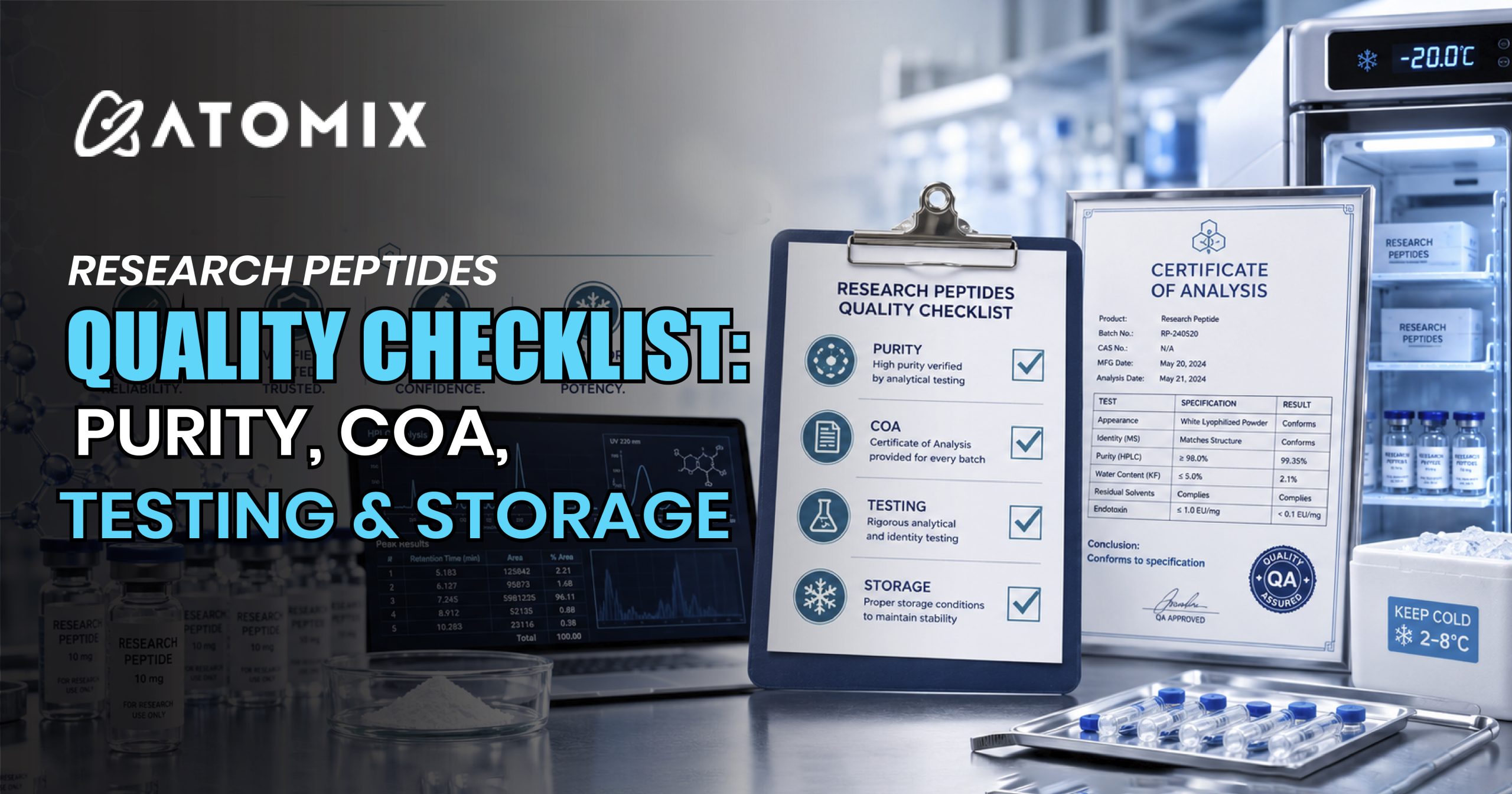
When you are sourcing research peptides for lab work, the decision is rarely just about price or availability. It usually comes down to one question: Can you trust what you are receiving?
In research environments where consistency matters, even small variations in quality can change outcomes. That is why having a simple, practical checklist helps you avoid guesswork and focus on what actually matters.
At Atomix Research, we often see that the most reliable results come from buyers who know exactly what to look for before placing an order. This guide breaks it down in a clear, no-confusion way.
1. Purity is the first thing to verify, not the last
Purity is often the first number people look at, but it is also the easiest to misunderstand.
A peptide labeled as high purity should ideally be backed by proper analytical testing, such as HPLC or mass spectrometry. These tests confirm that what you are receiving is actually what it claims to be.
In real terms, higher purity usually means fewer unwanted compounds in the sample. That matters because impurities can quietly affect reactions, stability, or reproducibility without being obvious at first glance.
A good habit is to always ask how purity was measured, not just what the percentage is.
2. COA is your basic proof of quality
A Certificate of Analysis is not an extra document; it is part of the product itself.
If you are buying research peptides and a COA is not available or not specific to the batch you are receiving, that should immediately raise questions.
A proper COA should clearly show the peptide identity, purity result, testing method, and batch number. Without these details, it becomes difficult to confirm whether the product has actually been tested or just labeled.
In practical lab work, COA is what connects the product you ordered with the material you are actually using.
3. Testing methods tell you how reliable the data is
Not all testing carries the same weight. Some suppliers may mention testing, but not explain how it was done.
In most serious research settings, HPLC is commonly used to assess purity, while mass spectrometry is used to confirm molecular identity.
What matters most is consistency in testing standards across batches. If testing methods keep changing or are not clearly stated, it becomes harder to trust long-term results.
A reliable supplier will not just say the product is tested; they will show you how it was tested.
4. Storage and handling affect everything after delivery
Even a well-manufactured peptide can lose stability if it is not stored correctly.
This is one of the most overlooked parts of research quality. Proper storage conditions help preserve structure and performance from the moment the product leaves the supplier to the moment it is used in the lab.
Key things to check include refrigeration requirements, protection from light and moisture, and guidance on how to handle reconstituted solutions.
If storage instructions are vague or missing, it often leads to unnecessary variability in results later.
5. Batch consistency is what builds long-term trust
One of the biggest frustrations in lab work is getting a product that performs well once and differently the next time.
Batch consistency is what prevents that problem.
A reliable supplier will ensure that each batch follows the same production standards and testing protocols. This means results stay predictable across time, which is critical for repeat experiments.
If possible, always check whether batch records or traceability information are available.
6. Transparency is often the easiest quality filter
Sometimes you do not need to overanalyze. You can learn a lot just by how open a supplier is.
Clear labeling, accessible documentation, honest product descriptions, and straightforward communication usually indicate a more reliable operation.
If information feels hidden, overly vague, or inconsistent, it is usually better to pause and reassess.
Good suppliers make it easy for researchers to verify what they are buying.
Final thoughts
Choosing research peptides is not only a procurement task, but it is also part of the research process itself. The quality of what you receive directly affects the quality of what you discover.
A simple checklist, like purity verification, COA review, testing clarity, storage guidance, and batch consistency, can save a lot of uncertainty later on.
When these basics are in place, research becomes more stable, more predictable, and ultimately more useful.
That is the standard we aim to support at Atomix Research, where clarity and consistency are treated as part of the science, not an afterthought.