

Research Journal
Research Peptide Reconstitution: A Step-by-Step Lab Guide

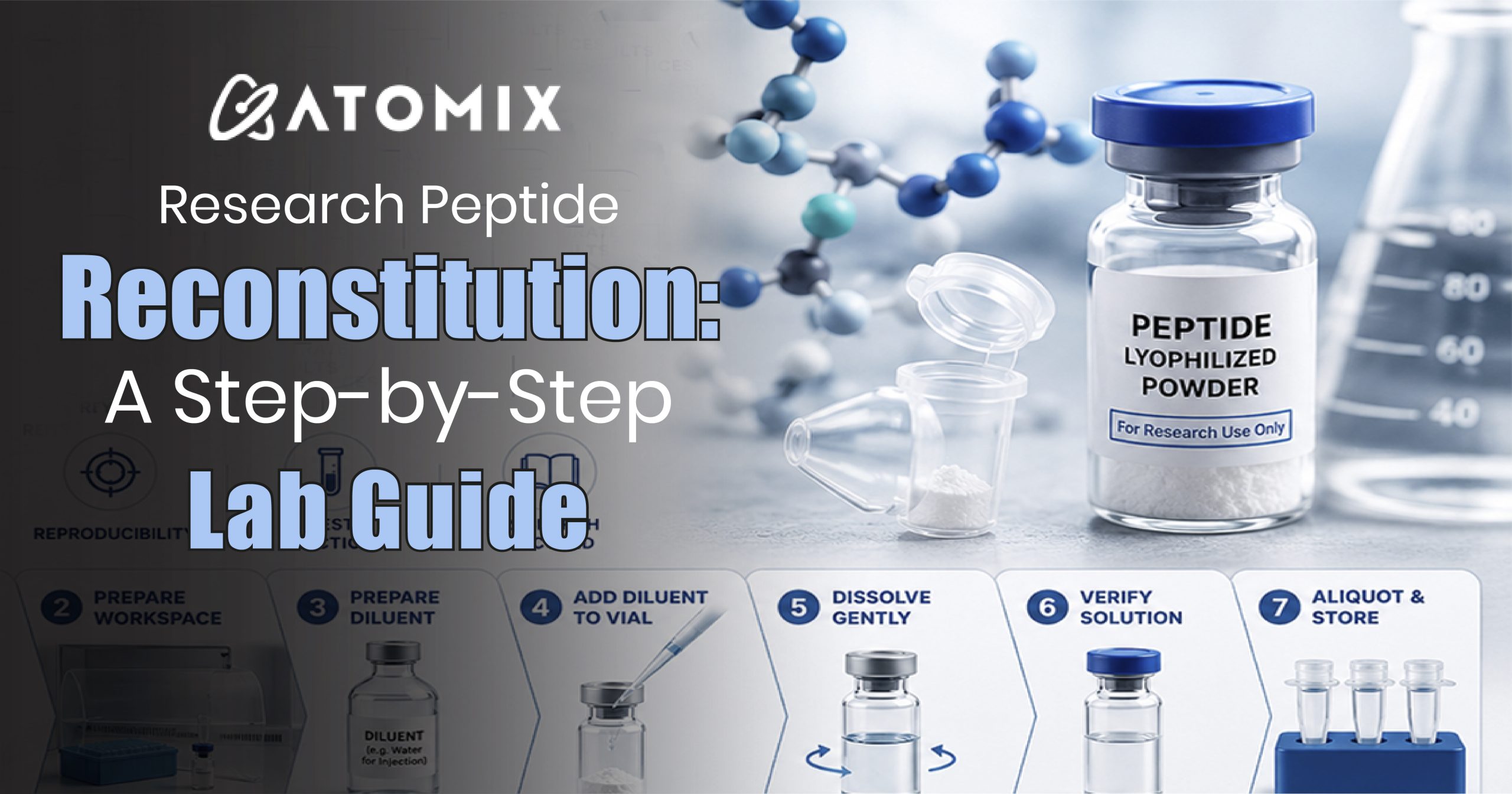
In any research setting, peptides are only as useful as their preparation. Even high-purity material can deliver inconsistent results if it is not reconstituted properly. That is why this step matters more than it often gets credit for.
Reconstitution is not just about “dissolving a powder.” It is about restoring a compound into a usable, stable form without compromising its structure or performance.
At Atomix Research, we see reconstitution as one of those quiet steps that separates smooth experimental workflows from unpredictable ones.
This guide is meant to give you a clear, practical way to approach it in a lab environment.
Before you begin, understand what you are working with
Not all peptides behave the same way once they are lyophilized. Some dissolve easily in aqueous solutions, while others require more careful handling to maintain stability.
Before adding any solvent, take a moment to confirm:
- The peptide’s storage condition history
- Its sensitivity to temperature and light
- The intended use concentration range in your study
This helps you avoid unnecessary trial and error once reconstitution begins.
Step 1: Bring the vial to room temperature
Cold peptides are more likely to form condensation inside the vial, which can affect accuracy when adding solvent.
Let the vial naturally reach room temperature before opening it. This small step helps maintain consistency and reduces the chance of moisture interference.
Avoid forcing this process with heat or direct warming, as that can affect peptide integrity.
Step 2: Choose the correct reconstitution liquid
The choice of solvent depends on the chemical nature of the peptide and the intended application in research.
Most commonly used options include sterile water or bacteriostatic water, depending on lab protocols. In some cases, mild acids or buffers may be required for peptides that are less soluble.
What matters most here is compatibility. The solvent should support stability without altering the structure of the peptide.
Step 3: Add solvent slowly and carefully
This is where precision matters more than speed.
Instead of injecting the liquid directly onto the powder, allow it to run gently down the side of the vial. This reduces the risk of foaming or structural disruption.
Slow addition also helps the peptide hydrate evenly, which supports better consistency in the final solution.
Step 4: Let it dissolve without agitation stress
Once the solvent is added, resist the urge to shake the vial aggressively.
Most peptides will dissolve on their own with gentle swirling or slow inversion. Excessive agitation can introduce air bubbles or stress the molecular structure.
Patience here often leads to better stability in downstream use.
Step 5: Check clarity and consistency
After full dissolution, the solution should generally appear clear and uniform, depending on the peptide type.
If you notice undissolved particles or cloudiness, it may indicate incomplete solubility or incorrect solvent choice. In such cases, it is better to reassess rather than force the process.
Consistency at this stage is a good indicator of whether the reconstitution was successful.
Step 6: Label and document immediately
Once prepared, the solution should be clearly labeled with:
- Peptide name
- Concentration
- Date of reconstitution
- Storage conditions
This is not just good practice; it is essential for reproducibility. In multi-day or multi-batch studies, proper labeling prevents confusion and protects data integrity.
Step 7: Store under appropriate conditions
Reconstituted peptides are generally more sensitive than their lyophilized form.
Most require refrigeration and protection from light. Some may degrade faster depending on structure and concentration, so storage guidelines should always be followed strictly.
Avoid repeated freeze-thaw cycles whenever possible, as they can reduce stability over time.
Common mistakes that affect results
In real lab environments, issues rarely come from the peptide itself. They usually come from handling.
Some of the most common mistakes include:
- Adding solvent too quickly
- Using incompatible diluents
- Over-shaking the solution
- Poor temperature control during preparation
- Inconsistent storage after reconstitution
Avoiding these small errors often improves reproducibility more than changing anything else.
Final thoughts
Reconstitution is a simple process on paper, but in practice, it directly influences how reliable your results will be. A well-handled peptide behaves predictably. A poorly handled one creates variability that is hard to trace later.
When done carefully, this step ensures that what you measured in the lab truly reflects the quality of the compound and not the preparation process.
At Atomix Research, we believe good research starts long before the experiment begins. It starts with how every material is handled, right down to the first drop of solvent.